
..........................................................................................................................................................................................................
prevention

by comparison with 2024, the hebrides have already experienced more invasive weather systems, with the proximity of storm floris to the past weekend's storm amy hopefully not the setting of a precedent for the rest of the autumn/winter season. though tiree recorded a gust of 153kph (a smidgeon higher than the 130kph experienced on islay), there was scarcely a problem for the intrepid velocipedinist, becasue, in the case of yours truly, i was comfortably indoors watching the wind do its level best to flatten my garden fence. we are extremely fortunate to have a power generating station on the outskirst of bowmore; when the power connection from the mainland failed on friday evening, it took barely an hour to fire up the diesel generators and switch the power back on across the island. even as late as sunday afternoon, power to west coast towns in argyll & bute had yet to be restored.
storm amy was, however, a stark and forceful reminder to put away my bibshorts and short-sleeve jerseys and check that my waterproofs and bibtights are in perfect working order. but it's not only the apparel that needs checking, more prudently, it's also the bicycle(s). though it would be a real optimist who would describe the last few months as the archetypal summer; i recall mentioning to anyone within earshot, that we appeared to have been receiving summer 2025 in instalments. a few days of warm sunshine were almost immediately followed by two or three days of cloud and rain, a repetition that continued from may until september. that repetition has now ended.
i have written at length about my obsession with keeping a clean chain on my bicycles, if for no other reason than making it easier to note any potential problems with the transmission. but chain aesthetics are no substitute for timely replacement, not only to prevent shifting improprieties, but needlessly having to swap out the cassette at the same time. it seems glaringly obvious, but apparently not to everyone, that as the chain wears, it creates wear across the cassette sprockets. in the days of freewheels and prior to shimano's invention of their hyperglide ramps, sprocket teeth were remarkably sturdy; when hyperglide first appeared, the tooth profiles resembled what were once identified as seriously worn. it's possible, therefore, that today's transmission systems, while a great deal smoother than their predecessors, are less robust.
my first road bike was a plain gauge steel viscount with a somewhat rudimentary approach to componentry, yet i have no recollection of ever changing the chain, despite riding the bike in such a condition for more years than i'd care to admit. but without indexing, there was far less likelihood of the problems of which many contemporary cyclists are still blissfully unaware. the rule of thumb would contend that modern chains, even those entrusted with a 1x transmission, ought best be replaced at around 3,000km. the problem is, unless you're in the habit of uploading each and every ride to strava or some similar service, keeping even a mental note of the distances cycled is more likely to result in unverified guesswork.
for instance, following my health scare a few months back, i have, of necessity, curtailed the average distances cycled at a single sitting. saturday's bike ride was a mere 30km, and sunday's only ten kilometres more. that's 70km over the weekend. if that were to persist, each month i'd ride around 300km per month; 3,600km per year. so, based on the above, i really ought to change my chain once per year. but prior to troubling nhs highland, my weekly kilometreage would have been closer to 130km, meaning a new chain every six months. that would mean that my current chain would be in deficit, were it not that i tend to share my cycling between two bicycles. assuming that we all adhere to velominati's rule #12, we all have the problem of keeping tabs on chain and cassette wear across multiple bicycles.
a first world problem.
either way, unless you've only recently replaced one or more chains, it might be prudent to to so before the end of the month; a broken chain, many kilometres from home in the midst of inclement weather is a situation most of us would prefer to avoid. though i still do not own a mobile phone, the extremities of several islay parcours are in areas where a phone signal is either on the fragile side, or completely non-existent. the best solution is to avoid such intrusions altogether.
don't dither; do it now.
monday 6 october 2025
 ..........................................................................................................................................................................................................
pay attention
i am at the lowest level of musical appreciation, by way of the bands in which i normally play a part. by this, i mean that we are generally regarded as background music, albeit a tad louder than that experienced in the average elevator. when the band in which you play chooses to present cover versions of well-known or obscure tunes, there is little onus on the audience (if they can actually be described as such) to express any appreciation for our efforts. in fact, it is more common either to be ignored completely, or be the subject of bizarre requests. a blues band in which i played in the early part of this century, was once asked if we played any pink floyd, and the three-piece of which i am frequently a part, is highly likely to be asked to render a song originally presented by a far larger band.
so, while the proprietors of local hostelries are generally quite happy to provide a fee for the evening, customers rarely find it incumbent to express pleasure at our choice of set list. bands who experience this level of indifference are definitely not those to whom record companies offer recording contracts. an event such as the caol ila islay jazz festival is at an entirely different level; many of the participants are already recording artists in their own right, while the audience has often paid a more than nominal sum to sit expectantly of and afternoon or evening of music they specifically wish to hear.
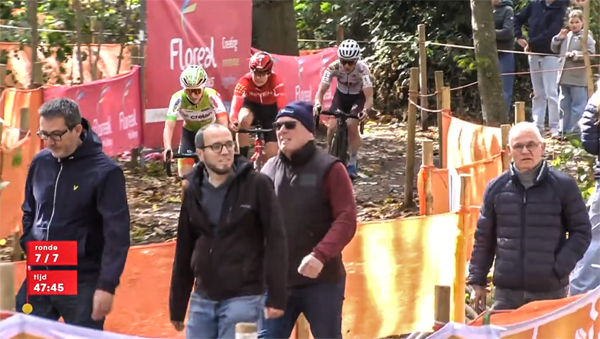
the latter is, i would imagine, similarly applicable to spectators attending the first televised cyclocross race of the season in western flanders. as i write, i have just finished watching the first exact cross event taking place in meulebeke, both women's and men's races, the former with a fairly minimal entry, but the latter sporting a substantial start-line, the only two major absentees (as far as i could see) being eli iserbyt and thibau nys. yet, during the women's event but only tangentially in the men's race, it was common to see groups of people on our side of the barriers, standing in small groups chatting amongst themselves, effectively ignoring the racing taking place around them.
as the women entered the final lap, i observed a group of what i hesitate to call spectators, walked stridently in the same direction as the competitors, yet paying no attention whatsoever to a race they had presumably paid an entry charge to watch (see image above). obviously enough, what people do within the spectator section of a cyclocross parcours, is entirely their choice; it's their money, so they can do as they please. but why would you travel to such an event, pay the requisite entry fee, then ignore the racing? could that not be considered disrespectful?
consider it from the competitors' point of view. as highlighted by the commentators, many of those racing had already begun their 'cross season participating in earlier, non-televised events, following a summer of stage racing, kermesses and high-level training camps, all designed to bring them to the start-line with honed physiques, not only to aid the quest for finish-line success, but to ensure a quality afternoon's entertainment for the spectators. it is all part of being a professional. yet, for an inordinate number, it seems that the effort was all for nought.
get a grip, people!
sunday 5 october 2025
..........................................................................................................................................................................................................experience
my regular reader will be acquainted with my usual habit of cycling south west on alternate friday afternoons to deliver copies of the community newspaper to debbie's in bruichladdich. this was a fortnightly task initiated during the pandemic when there was realistically, no other practical and timeous means of effecting delivery. nowadays, things have changed for the better, in that a recently recruited member of staff, who works only until 1pm on fridays, lives in portnahaven, around 12km farther south, with a direct need to travel through bruichladdich on the way home. thus, it would be perfectly possible for her to deliver the papers on each fortnightly occasion.
but, if you'll excuse my enthusiasm, where would be the fun in that?
i have reiterated almost to the point of boredom, the admission that i am very much a creature of habit. for instance, at almost exactly 13:35 each weekday, i sit in my computer chair and upload that particular day's edition of the post. granted, occasionally circumstances prevent that being the case, but assuming there to be a following wind, that's precisely what will happen (weekends are a different kettle of fish). and that's not my only example of routine behaviour.
cycling to debbie's every second week does, of course, have its advantages, not least of which is the opportunity to sup a soya latte as reward for my troubles, and, perchance a small square of millionaire's shortbread. there's also the possibility of collecting a bag of green city jumbo porridge oats, as the receptacle in which i carry the newspapers is just the right size. as the saying goes, what's not to like? additionally, the owner of port charlotte stores frequently meets me at the croft and we both pedal south west, accompanied by another member of the velo club peloton who invariably has fridays off work.
but, it will probably not have escaped your attention that we're not in kansas anymore; the weather has turned inclement (to which i can directly testify, having been soaked for two days in a row) and this particular weekend has seen the arrival of the first named storm of the season: amy. we have previously discussed the efficacy of providing adverse weather systems with names (might it be an idea to also name periods of balmy weather?), a practice which invariably leads to hours or days of concern. having lived in the hebrides for almost forty years, strong winds and horizontal rain are a part of my birthright, and certainly not unexpected at this time of year (nor is it unexpected during the summer months, but that's another story altogether).
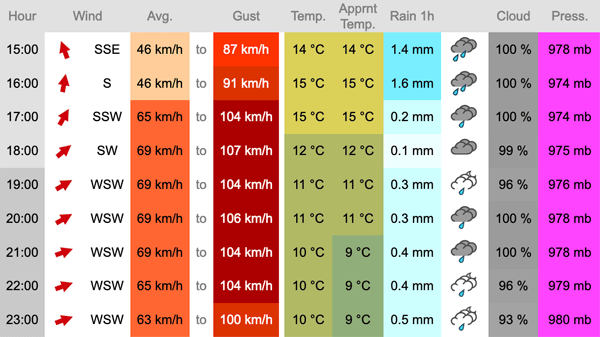
having checked three weather forecasts for the first part of the weekend, there's no argument over the fact that the winds will be in excess of 100kph, but two forecasts have them as high as 120kph. whether any of us can actually tell the difference is something of a moot point. however, where once, my younger self would have (literally) cast discretion to the wind, i have become a tad more open to my own persuasions and sense of safety. i have, inadvertently, cycled in 100kph winds on previous occasions, and, while i lived to tell the tale, i wouldn't be inclined to recommend such an undertaking, were there to be a lesser option.
having witnessed enough weather forecasts that scarcely fulfilled their prognoses, though it may have appeared that i could have made it to debbie's in one piece, and perhaps enjoyed a salutory tailwind home, timings were a touch on the close side, with the sword of damocles hanging over the wrong choice. at the time of writing, i am witnessing torrential rain streaming down the sitting room windows, while the bramble bushes bordering the back garden are being both shaken and stirred, often both at the same time. staying at home is currently being confirmed as the correct option.
with all ferries cancelled this afternoon and this evening, as well as a dearth of sailings on saturday, i can but look forward to watching the beginnings of the european cyclocross season from the comfort of my own home this afternoon.
but i'll have to make my own coffee.
saturday 4 october 2025
..........................................................................................................................................................................................................overbearing

perhaps some of you might recall adverts in the weekend supplements, depending on your choice of saturday or sunday newspaper, in the middle of the first decade of this century, from a company by the name of sterling house. these advertisements frequently offered his and hers mountain bikes for a combined price of £99.99, an offer seemingly regarded as unmissable by several of my acquaintances and neighbours, judging by the number who subsequently contacted me to assemble them on their behalf. (sterling house appears now to be owned by sports direct). perhaps i need not mention that these so-called bicycles were rarely safely constituted; one i specifically recall had one skew-wiff dropout, preventing the axle nut from being correctly tightened, and resulting in the wheel immediately pulling to one side due to the application of pressure to the leftmost pedal.
on contacting the manufacturer to point out the error of their ways and enquire about their returns policy, i was told simply to dispose of the bicycle, and a replacement would be sent out forthwith. oft-times, the accompanying instruction manuals detailed affixation of quick-release skewers, when both wheels featured solid axles, and at least two accessory boxes contained two left-threaded pedals. very much a case of 'caveat emptor'.
many customers, along with yours truly, seriously wondered how it was possible to sell complete bicycles for around £50 each, yet still realise a profit. one of the cycle accessory suppliers with whom i dealt, advised that they'd found their own sales to have diminished as several of their own customers were buying these bicycle-shaped-objects and stripping the frames of their components for resale. at the time, a front wheel could retail for £20 and a rear wheel for £25, meaning everything else on the bike had cost the purchaser a mere £5.
it is possible that sales and advertisements for such items were responsible for the sharp intake of breath when the great unwashed learned the price of the machinery ridden by members of the velo club sunday peloton. it was hard to point out that the campagnolo seatpost on my colnago cost more than two sterling house velocipedes. a gent visiting my next door neighbour was aghast at the price of my chorus equipped steel colnago superissimo, despite having arrived in £40,000 worth of sierra cosworth. horses for courses, i suppose.
those days are now twenty years distant, and i'm sure it's quite probably still possible to purchase budget-priced bicycles that may be slightly better in construction, but are every bit the modern version of a bicycle-shaped-object. campagnolo no longer offers seatposts of any flavour (more's the pity), but used versions still retail at around the costs of an alloy version in 2005. however, pretty much every other aspect of cycling has dramatically increased in price; last week's comic featured a review of canyon's latest bicycle, retailing at a less than comfortable £12,000, roughly the price of an entry-level harley davidson motorbike.
but it's not just the entire bicycle that has pushed the price envelope; the simplest of components has seemingly followed suit.
the two bicycles of which i make most use (a steel ritchey logic road bike and a carbon specialized crux cyclocross bike) feature the simplest of integrated headsets consisting of steel inserts into which bearing races can be easily dropped. not for me the expanding tool to remove top and bottom bearing cups and the logistical and technical nightmare that surrounds removal of a brinelled crown-race. i am sufficiently unimpressed in the purported advantages of employing ceramic headset bearings, not to shell out for just such items. i can see how ceramic bearings make a difference in bottom brackets, hubs and even derailleur jockey wheels, but considering the limited movement required by a headset, i remain to be convinced.
and that convincing would need to move up a gear on learning that a pair of ceramicspeed ceramic bearing headset races would potentially relieve me of almost £230. in june 2023, i replaced the headset bearings on my ritchey with genuine ritchey parts; including postage, those cost £31.45. literally, double-standards.
am i missing something?
friday 3 october 2025
..........................................................................................................................................................................................................the name game

britain's national cycle network skiffs the outer edges of the mainland coast opposite the hebrides, and if i understood the markings on the ordnance survey map, i could better educate both you and i as to whether the dotted black line entails a projected route, or one that's not quite all there. bearing that indecision in mind, the closest point at which i might join this impressive network of cycle paths would appear to be kennacraig in west loch tarbert, from where the ferry to islay and jura departs. i must point out that i am unaware of anything resembling a cycle path that joins kennacraig with the village of tarbert some eight kilometres north, which would tend to suggest that the black dotted line might just represent a projected addition to the network.
we might never know.
the network, some 20,500 kiometres long, is curated by sustrans, an organisation founded in bristol in 1977 by a group of cyclists and environmentalists concerned about the impact of the motor car on british society, and a lack of the kind of cycling provision prevalent in several european countries. it's a charitable organisation that gained much of its notoriety by making use of disused railway routes, closed during the beeching cuts almost a decade earlier. the first of these was the bristol and bath railway path a rhyming benefit to cyclists and walkers in that part of england. the charity has, for forty-two years (charitable status was achieved in 1983), been at the forefront of planning and building the network. there does appear to be a section of the network joining the northoern portion of the western isles with its most southern tip, but delineated as it is in the same broken black line, i could be well wide of the mark.
perhaps obviously enough, sustrans is an abbreviated version of sustainable transport, a title surely applicable to all manners of transport (walking, cycling, etc.) that eschew involvement of the motor car. however, the name itself is really of no nevermind; whether you previously understood the origin of the name is of academic interest. the national cycle network may exist at the behest of sustrans and its funders, but exist it does, irrespective of how its administrators are named. so why, you might ask, would they bother to change the name to something as clumsy and juvenile as the walk wheel cycle trust as it publishes its new strategy, projected to last from 2025 until 2050? to add insult to injury, the strategy appears to be entitled, because people-powered movement changes everything.
ceo, xavier brice encapsulated this vision for the future, stating, "Uniting under a new name and a renewed mission to deliver more joy per journey, more peace per pedal, more smiles per mile." i would seriously question the ability of an organisation now labelled, walk wheel cycle trust to "...deliver more joy per journey", whatever it is that phrase actually means. sustrans will not be the first and certainly not the last, to needlessly change its official title. just down the road from my office sits the offices of naturescot, previously known as scottish natural heritage, and before that, the nature conservancy council. had this particular organisation changed an aspect of its environmental remit, i could perhaps have understood its inveterate name-changing habit, but in point of fact, naturescot is no different than the nature conservation council.
so what could possibly have been the reason behind morphing sustrans into something definably less pleasing to the ear? the closest i have found by way of an explanation also originates from the chief executive officer, to wit, by working with others, (we) will realise our purpose of making it possible for everyone to walk, wheel and cycle." despite brexit and other stupidities, i believe we consider ourselves to be domiciled in a civilised society, closing in on the dream of equal opportunities, and doing our best to offer uk residents a fair and equitable society in which to live and, hopefully, prosper. so why then, does an independent charity think that we require its assistance to walk or cycle? is this not something we are largely capable of achieving all on our own? i will query the sunday peloton, but i think we all learned to cycle at the behest of agents (our parents) other than the idiotically named walk wheel cycle trust, a title i believe i will now refrain from using, as i feel particularly stupid doing so.
the revolution may not be motorised, but is revolution really the word we want to use? perhaps insurrection might be a more appropriate choice. or maybe unfortunate disturbance? who's up for a focus group?
thursday 2 october 2025
..........................................................................................................................................................................................................he who pays the piper...

the internet has a long and varied history for something that some of us regard as a relatively recent invention, while others, mostly those born in the 21st century, hold it in similar regard to water, electricity and (decreasingly so), television. originally developed from the arpanet, a system invented to allow the military to keep in contact and send digital files, the internet has become entirely ubiquitous, unless, of course, you live in afghanistan where the ruling taliban have reputedly severed fibre-optic cables to end internet access across the country. if you're reading this, you are obviously connected to the internet, and such is its ubiquity, few even consider the ease of connection these days, as your computer, phone or tablet seamlessly connects to the nearest router. a far cry from the days of plugging a lengthy cable into the house or business phone line and dialling into a remote server to gain access.
early experiments in american universities eventually fostered what is now referred to as the internet of things, connecting previously dumb machines and devices to allow them to be queried remotely, or to send information on demand. these early experiments connected the likes of drinks and food machines, allowing an individual to check if the cola machine in the hall was stocked with the desired beverage. this has since been expanded to the likes of domestic refrigerators, allowing shoppers to check whether they already have enough yoghurt, milk or cheese for a weekend's consumption, while they amble round the aisles of the local averagemarket. whether this is of instrinsic benefit is something of a moot point, when once it was customary to check for such items prior to heading to the shops.
as many cyclists will already be accustomed, it smacks of technology for the sake of it. it can be done, therefore it has been.
i recall reviewing a pair of bicycle lights which could be controlled via a smartphone app, allowing the user to alter the frequency of the flashing pattern and check the battery status while observing the bicycle through the kitchen window. those lights could also reputedly connect via a smartphone and a central server, to inform other users of any traffic holdups or roadworks on the daily commute. this latter feature i was unable to verify having a) no smartphone, and b) insufficient local users with whom to form an information network. however, it didn't strike me at the time as an ideal safety routine to be paying close attention to smartphone alerts while attempting to negotiate city-centre and urban rush hour traffic.
however, the inventors and manufacturers of such technology are constantly on the lookout for hitherto untapped markets, ostensibly for the benefit of their users, but, conspiracy theories abound that these market searches are designed more to benefit themselves than their direct customers. consider, if you will, strava. for around £120 per year, they will provide you with your own page on which to record each minute detail of the sunday ride, 'talk' with friends and various other advantages. many will view the cost of an annual subscription as perfectly acceptable, but you should bear in mind that all the information you post on strava informs them to a substantial degree, providing data which they are happy to sell to the highest bidder (usually transport planners and the like). the data at this point, is anonymised, but nonetheless, strava have just charged you money to provide them with free information. just like facebook.
i did not, you will be surprised to learn, randomly choose those two technologies, for were you to purchase a pair of oakley's latest cycling glasses, the meta vanguards (£499), you will not only be able to film a cyclist's eye view of your bike rides, but integrate your experience with either facebook or garmin to "access real-time personalised performance insights". however, should you wish to bolster your reputation as 'coolest cyclist on the planet' while viewing the world through your expensive oakleys, just bear in mind that however much facebook or garmin provide, there's a greater than evens chance that you're providing them with even more.
and it didn't cost them a penny.
wednesday 1 october 2025
..........................................................................................................................................................................................................bicycles and the avant garde
over the course of the weekend, in the spare moments i had available, i came across a two-part series on youtube, entitled jazz and the avant garde, designed, i presume, to introduce the layperson, as well as the jazz aficionado, to an offshoot of the musical genre that is, to put it politely, a little left of centre. as someone who likes to think of himself as reasonably well-informed as to the facets of jazz that are of particular interest (mostly swing and be-bop) i took the opportunity to acquaint myself with a facet of jazz in which i have only a passing interest.
for those who perhaps are aware of that of which i speak, the avant-garde, in this case, could be considered as beyond be-bop, the latter principally embodied by music from max roach, dizzy gillespie, charlie parker, early john coltrane and perhaps, miles davis. if those names mean nothing whatsoever, you may wish to research a bit further, but, for the large part, so doing should not necessarily be considered a compulsory part of understanding to what today's monologue refers. suffice it to say, avant-garde jazz may require more work on behalf of the listener than it did of the performers, and there is a strong case for stating that several examples may have been more enjoyable for the performers than it is for the listener.
i am, however, a firm believer that no genre of music or visual art should be discarded or disparaged without first attempting to acquaint oneself with the reasons and strictures that brought it to being in the first place. i confess that in my teens, i had a bit of a struggle with be-bop, based entirely on a lack of understanding of what was happeneing before my ears. once i became even tangentially aware of the form, those sounds began to make a great deal more sense, even if there are still several examples that remain outside my sense of musical aesthetics. not everything is as straighforwardly simple as pop music, and i am not averse to putting in a bit of effort if i think there might be reward at the end of the rainbow.
if i might provide this discourse in a sense of perspective, there was a time when the band roxy music were considered perilously close to avant garde in their output. listen to the first, self-titled album and its successor, for your pleasure, when their sound was still influenced by original member, brian eno and compare it with contemporary releases of the early 1970s. never would i class roxy music as anything close to jazz, but given that they are now widely regarded as a pop band, this may give a credible example more familar to many.
it has been argued that the classification avant-garde could theoretically be applied to almost any endeavour of which you care to think, though it tends to be more readily applicable to music and the visual arts. translated from the original french, it describes 'experimental, innovative, and often radical ideas or practices', and i wondered whether it might be applicable to the velocipedinal realm? the most recent example of which i can think would probably be the scots maverick that is graeme obree, a man who seemed largely free of the constraints placed upon the majority of us either by industry marketing, or straightforward complacency. and just to be clear, i would scarcely use avant garde as an adjective to describe yours truly, given my manifest acquiescence to the norm.
i find myself constantly troubled by the notion of matching a jersey from one marque with bibshorts from another. hardly what you'd call reactionary.
though i have no idea of graeme obree's whereabouts or current occupation, i doubt many would disagree with my description of him as a member of the avant garde. but, try as i might, i can think of no others within the modern idiom. it cannot be, however, that the size and strength of the bicycle industry is such that it has effectively quashed any thoughts of differentiation from the middle way, for arguably the worlds of art and music are its equal or greater. from my understanding, the avant garde as defined, exists outside the straight and narrow because it finds those constraints to be particularly limiting. so despite all its foibles, perhaps the cycle industry does not exhibit such tendencies. i confess that rarely have i lifted one or other bicycle from the bike shed, only to be defeated by its intrinsic normality. if we accept that form follows function, it's an epithet that the majority seems to have fulfilled most adequately. no doubt there will be those in thrall to the bicycle recumbent who may think otherwise, but that is a subjective option open to continued debate; categorising avant-garde music or art is rarely the subject of dispute.
graeme obree demonstrated, without perhaps intending to do so, that bicycles and the riding of them does not need to be conventional, something that, i'm sure you'll agree, none of today's professional peloton portray. so is it imperative that a velocipedinal avant garde exists? in the realm of cycling apparel, there are a few who would consider themselves disruptors, but in most cases that is the result of self-satisfied marketing. a bit like a non too distant distillery, that regards itself as progressive, despite making whisky in the same manner as its nine neighbours.
let's face it, though many might consider us just the wrong side of eccentric, we're hardly to be found at the cutting edge of sporting endeavour or the transportational vanguard.
tuesday 30 september 2025
..........................................................................................................................................................................................................