
..........................................................................................................................................................................................................
handcrafted bicycles: builders, frame design, and inspiration. christine elliot & david jablonka. schiffer publishing hardback. 256pp illus. £45.99

from around the middle of the first decade of the 21st century, the profile of the handbuilt bicycle almost suddenly became a thing. in 2005, the north american handbuilt bicycle show first reared its head in richmond, virginia, allowing the new breed of frame builders to exhibit their wares, effectively re-establishing a tradition that had all but been subsumed by the wholesale shift to mass-market carbon fibre. admittedly, over time, one of two of those at the vanguard of the movement subsequently explored the possibilities of handbuilt carbon, but in the main, steel was the weapon of choice.
there are several reasons for this, but likely settled on the fact that, relatively speaking, steel is cheap and readily available, as are the tools required to transform tubing into bicycle frames, and the resultant product is strong, sturdy and easily repairable. it should probably also be pointed out that, with a bit of initiative, building with steel could be managed in a garage space, without the need to rent substantial premises.
during my first trip to portland, oregon, i visited several workspaces which were rudimentary at best, yet perfectly adequate for the purpose.
it wasn't too long before the desire arose to handbuild bicycle frames on this side of the atlantic, leading to the establishment of bespoked bristol (subsequently shortened to bespoked) in an annexe of bristol railway station. the popularity of such a venture can perhaps be gauged by the fact that the expo was once held in the olympic velodrome in london, attended by the man who re-invented the headset, chris king.
unless you happen to be in the market for a handbuilt, custom bicycle frame, you might be forgiven for thinking that the euphoria had diminished to the point of dissolution. but you'd be wrong, something that christine elliot & david jablonka have effectively proved beyond question in their substantial tome, handcrafted bicycles. the research for this large publication must surely have occupied a great deal of time, with 32 builders highlighted from seemingly every corner of the world. accompanying each chapter is a copious number of illustrations showing not only the differences, but in effect, the similarities between bicycles hailing from a total of thirteen countries, including north america, the uk, france, the netherlands and several other nations. i'm not entirely sure what that actually proves, but it does highlight that a bike, is a bike, is a bike, no matter its country of origin.
the non-believer might well question the purpose behind the book; mrs washingmachinepost most certainly would, having claimed on several occasions that "it's only a bike". the authors quote respected uk builder, richard hallett as saying, "A metal frame, two wheels, pedals, a seat, and handlebars - on first glance, bicycles look pretty straightforward." depending on your point of view and indeed, that of the builder, creating bicycle frames can be considered a trade, profession, artistry, craftsmanship, or fabrication. either way, you hopefully end up with a bicycle that suits your sense of aesthetic and purpose. how much that costs, depends on a wide variety of factors; price is one of the factors never mentioned within the book.
many of the builders cite similar reasons for pursuing this particular line of work: " i strive to have a client engaged in their frame from conception to hand-off"; "it's gratifying when a customer can come pick up their bike in person"; "when they receive the bicycle in person, you can see in their eyes the reward of this journey." but where the majority detail their love of bicycles and the paths that led them to become framebuilders, demonstrating a not unexpected similarity in many cases, the one who stands out in this respect is richard sachs, the chapter on whom begins, "I didn't want to be a bicycle maker; I became one,"
"To make a better bicycle so that those in whose corners I sit will have the best tool for the job."
there is, of necessity, a repetition across the book's chapters, yet the authors appear content to leave the reader to draw their own conclusions (assuming there are conclusions to be drawn) as to why the handbuilt bicycle still exists. is it because there are those who see it as their life's obsession to make bicycles, or because there persists a desire on behalf of many of the world's cyclists to own just such a handcrafted 'tool' (to quote richard sachs)? though the narrative remains consistent across the book's 250+ pages, it's not necessarily a book that demands it be read from start to finish. it may be a case of picking and choosing dependent on taste and interest.
but even if you harbour a peloton of carbon bicycles in the bike shed, ready and willing to dispute that steel is, in fact, real, there's a certain comfort to be gained from knowing that there are still those with skills and purpose to maintain a lengthy tradition, happy to provide that which many desire, rather than settle for what the industry tells us is good for us.
handcrafted bicycles is published in the usa on 28 september and in the uk on 28 november 2025.
monday 29 september 2025
 ..........................................................................................................................................................................................................
simply the best

today's discussion is reminiscent of our recent discourse on the world's fastest bike, an undertaking implemented by a major cycling publication in a wind-tunnel in order to return a sole victor. it was my pleasure to highlight the fact that road bicycles (and the majority of related genres) are, in and of themselves, incapable of unassisted motion, therefore implying that the world's fastest bike would surely find itself reliant on the world's fastest rider to achieve its desired aim? taking the final result of the tour de france, one might presume that the colnago y1rs could reliably stake claim to the title. however, only a matter of weeks later, in the absence of pogacar, the fastest bike had surely transformed to a cervelo s5?
it appears that perhaps the world's fastest bicycle is somewhat of a moving target, since everybody's favourite remco snatched the world time-trial championship while riding a specialized (albeit, one specifically constituted for time-trialling as opposed to generic road cycling). so does that mean that the definition of the world's fastest bike is the result of seasonal approbation? it's an argument that takes on an existential mantle, particularly if the victor of tomorrow's road world championship happens to be aboard a marque unaccounted for above. and since we now find ourselves inadvertently discussing the world's fastest road cyclist, a discussion surely independent of the bicycle idiom, perhaps that too, is worthy of our attention?
but that actually raises more questions than it answers, for as pointed out above, earlier this week, remco evenepoel was crowned men's world time-trial champon, ahead of jay vine and belgium's ilan van wilder. the first two might not be overly surprising, but third place must have raised an eyebrow or two, given that van wilder finished ahead of tour de france winner, tadej pogacar. suddenly, a colnago is but the fourth-fastest bike in the world. but is that really the case? though i haven't perused the start-line entry, i see no sign of filippo ganna in the top ten, and assume that he had not entered the fray. nor, indeed, is there any sign of matthew richardson, currently considered the world's fastest track cyclist over 200 metres.
of course, the world time-trial parcours was just over 40.5km, a touch longer than a 200 metre sprint, but that hardly negates extrapolation, giving richardson a competitive edge (incidentally, richardson was aboard a british cycling hope carbon track bike, so maybe that's the world's fastest bike?). however, even if richardson was ineligible, and ganna on holiday, there were one or two other quality time-triallists absent from the kigali entry list, most notably (i would have thought), vingegaard and van aert. so, fast though evenepoel undoubtedly was, can he realistically lay claim to the title of world champion, when such notable adversaries chose not to participate?
and that particular question can be carried forward to tomorrow's event. once again, we find vingegaard and van aert absent from the start-list, as is ganna, van der poel, and almeida. so can the winner truly be crowned world champion; the best in the world? if the latter is truly the aim of the uci, to have one rider wearing the rainbow stripes for the next twelve months, is a one-day race really the best means of achieving that? it's more or less the equivalent of exams versus continuous assessment. if the sport's ruling body truly wants to equate cycle-sport with that of formula one, should it not mandate that specific events across the season carry world championship status, entry to which is compulsory for perhaps the top 150 riders? it's obvious to see that such strictures couldn't possibly work, for what happens in a team sport when the domestiques required by jonas and tadej are outside that 150 as a lack of results while assisting their leaders to win one-day races and grand tours? matters are not made any more equitable by the insistence on national teams as opposed to trade teams. arguably, there are in-race negotiations to be made amongst riders from the same trade team, but of differing nationality.
far cleverer minds than mine have argued long and hard over alternative methods of choosing a world champion, but at every step of the way, incongruities have raised their ugly heads, leaving us with a road race that decides the wearer of the rainbow stripes. so peerhaps we should be asking the question, do we really need a world champion in any discipline? could it not take the form of a season-long competition, where points are accumulated in each uci event entered; miss out more than a few events at your peril. personally, i'm in favour of doing away with a world championship altogether, but that's probably only because every year, when the road race takes place, i'm on jura for the music festival and miss live coverage entirely.
saturday 27 september 2025
..........................................................................................................................................................................................................it wasn't meant to be this way
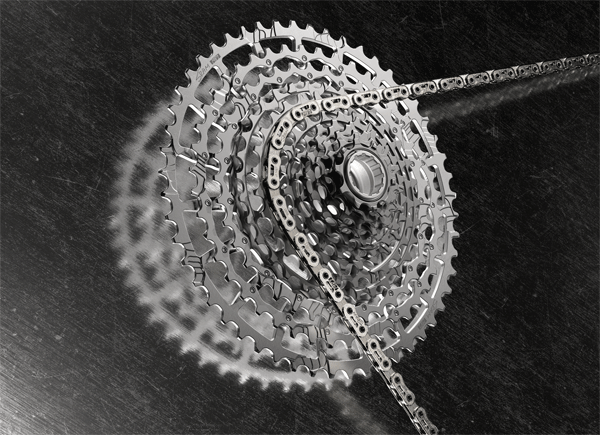
despite the dangers of following yesterday's monologue with something even vaguely relevant, there's an outside possibility that i might have achieved that very situation. the latter part of yesterday's scribblings concerned the widespread inappropriate use (or lack of) the ever-increasing number of gears available to the intrepid roadie. and strangely for yours truly, that article made mention of the endless march of technology to embrace the almost ubiquitous fact that many of our geartrains now operate at the behest of electrons, keeping us fresh for the finish-line sprint. but it appears that the aforementioned march of technology is intent on having the last word.
or, last two words, which, you will be totally unsurprised to learn are firmware and update, two words that really ought to scare the living daylights out of any self-respecting cyclist. the sad part is that it probably won't.
the progenitors of the magic words are the fine people at sram, purveyors of wireless electronic groupsets who, it seems, are embracing the possibilities offered by the new age. the technological advancements to which we will probably all have to become comfortable have effectively allowed the luxury of effectively admitting you got it wrong before providing a solution to the problem you didn't know you had purchased. whereas mechanical groupsets relied, to a greater or lesser extent, on you and i effecting a gearchange, or series of changes by the sweat of our own brows. therefore, if those changes were a tad on the slow side, we had only ourselves to blame.
electricity has now absolved us of all blame, in the same way that computers have made humans infallible. no matter that the wrong product was delivered through the mail, or the bike shop presents you with the wrong colour of bicycle frame, the computer is always to blame. it's incredible just how quickly the phrase, 'garbage in, garbage out' has become lost in the mists of time. in the case under discussion, yesterday, sram sent out a mailshot informing their customers (seemingly indiscriminately, since i don't own any sram wireless equipment), that firmware update 2.53.8 is now available for their eagle axs transmission cassette mapping (remember where you were when you first came across this distinctly non-velocipedinal phrase), accompanied by an explanation of just what that all means.
according to sram, the update has been released as a result of 'years of additional post launch testing, providing justification for having got it wrong in the first place. once applied, firmware 2.53.8 will allow shifts of three cassette sprockets or more, to move more smoothly across the block. this it achieves, apparently, by better aligning the derailleur with 'common cassette rotational speeds' (a phrase you might wish to drop into conversation over a latte and a toastie this weekend).
once again, you will be unsurprised to learn that there is an app to take care of the heavy lifting. ensuring that you have bluetooth switched on, users are instructed to connect the app to their eagle axs hardware, apparently one component at a time, ensuring that the firmware update is applied to each individual component. i seriously wonder just how many sram-owning cyclists thought they would ever find themselves in this position. though i'm always wary of making assumptions, i presume that sram have assumed that those of us without a mobile device are insufficiently in thrall with wireless technology to have acquired an eagle axs groupset in the first place.
this may be the first identifiable instance of a situation which cannot be undertaken without access to a mobile phone, otherwise known as the thin end of the wedge. i never, for a moment, thought it would be the bicycle that heralded the dawn of that particular era.
wednesday 24 september 2025
..........................................................................................................................................................................................................want of understanding
as you may already have suspected, there are many things that i do not understand. some of those things can be unravelled by strategic study, while others i am happy to leave on the periphery, unwilling to add them to my ever-decreasing armoury. but many of the things that remain incomprehensible will probably continue in that vein, because even when explained, the confuddlement continues anyway.
those of you in the habit of reading on a regular basis, will have learned that the absence of any discourse since friday, revolved around my weekend of percussive activity and attendance at as many islay jazz festival concerts as were found available and accessible. for what it's worth, a big shout out to trumpeter colin steele, pianist paul harrison and the husband and wife duo of zoe francis and jim mullen. and it was brief interaction with a couple of the drummers present that once again, highlighted a major area of incomprehension.
perhaps you will bear with me while i inform you about stuff in which you're not really interested.
modern drum construction has moved on by leaps and bounds from that of yesteryear, with even the most budget of shell packs providing quality that could only be dreamed of in the last century. do not, however, mistake quality, as mentioned, being the equivalent of sound quality. while the majority of audiences, even the most select amongst that number, are less than concerned about the actual sound of a drum, even the most wallet friendly of drumsets offers perfectly cut bearing edges (the part on which the drumead sits) and virtually perfectly round shells, creating an instrument that, assuming the drummer has a clue and an interest, can be tuned to the nth degree.
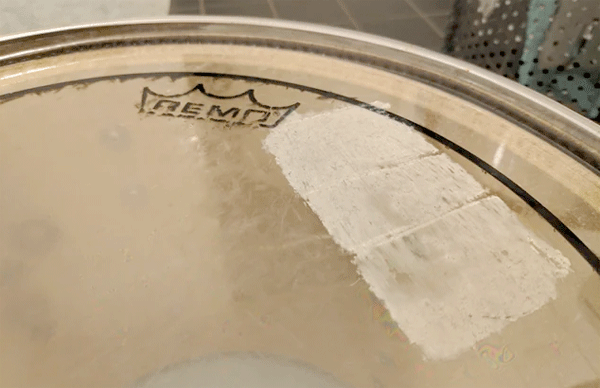
that being the case, both my drumsets and each of my snare drums, is tuned precisely the way i desire, and left un-troubled by any form of damping. the modern means of effecting the latter on snares and toms, is to apply small squares or circles of silicon to the playing head to undermine the overtones that can be heard when playing an undamped drum. on occasion, this might prove an acceptable solution when close-miking the drums in a studio or live situation. however, the venues occupied by the various jazz festival concerts scarcely demanded microphones positioned but a few millimetres from the drum. in essence, it is those overtones that allow the sound of the drum to carry to the audience, and when played along with accompanying instruments, those overtones blend into the overall sound.
but worse, any form of damping, from installing thick, double-layer drumheads, to placing cushions, duvets or towels inside the bass drum, immediately lowers the volume and tone of the drum. considering the substantial costs of many top level drumsets, i completely fail to understand why large amounts of money would be spent on state of the art drum manufacture, to subsequently apply the means of deliberately lowering the tone and volume of that purchase?
two of the excellent drummers i witnessed at the weekend both featured completely unnecessary (in my opinion) damping on at least snare and bass, and in one instance, both toms. i fear that there may be a case of follow-my-leader, without considering the result of such bizarre behaviour.
and such incomprehension stretches to many cyclists; predominantly those recently brought into the fold, but including many who really ought to know better.
consider the current state of the art in relation to modern-day road groupsets. in this respect, i am specifically thinking of the gearing systems. we have moved, in the space of three or four decades, from downtube friction-shifting across five rear sprockets, all the way to cassettes of thirteen, on which the chain is eased up and down by means of wireless electronics. in the case of campagnolo's wireless super-record, married to a double-chainset up front, the intrepid (and well-heeled) member of the cognoscenti is provided with a theoretical maximum of twenty-six gears. as the saying goes, 'we've never had it so good'. yet, on many occasions, observed from my now traditional place in the peloton best described as 'right at the back', i can observe an apparently increasing number of pedallists who put the chain in the eleven or twelve sprocket and big ring up front, and simply leave it there from the beginning of the ride until the very end.
though this errant behaviour could potentially be attributed to a misplaced sense of macho pride, in truth, it's a behaviour that transcends the genders. and where you'd think those practising such uninformed gearing would have the good sense to switch to something a tad more manageable when the road heads upwards, in many cases, you'd be sadly mistaken. where, i might ask, was the point of developing hyperglide and its variant forms to ease shifting of the chain while under load, if many of its purchasers barely ever change gear?
it is eminently possible that you may not realise that you are a fully-paid-up member of the above practice, nor indeed why you have eschewed the changing of gears in the first place. you may also have observed this very aberration in members of your own sunday morning peloton, and suffer similar incomprehension to my own. either way, i think it is now incumbent on the elders of the peloton to stamp out this behaviour before shimano, campagnolo and sram realise that they can dramatically cut costs by offering a single sprocket, since nobody bothers to change gear anyway.
thankfully, the world's drum manufacturers have refrained from immoveably affixing pre-damped drumheads to their drums, while sanding flat, those accurately cut bearing-edges.
tuesday 23 september 2025
..........................................................................................................................................................................................................